
TruPrognostics™ AI combines physics-based models, machine learning, and contextual AI to diagnose fault modes by name, forecast remaining useful life, and recommend the next inspection or maintenance action grounded in relevant operating manuals.
A discharge temperature that's high at full load may be normal. The same reading at half load may indicate intercooler fouling. Most compressor condition monitoring still treats each measurement in isolation, ignoring how operating conditions change what "normal" looks like.
The result is familiar: nuisance alarms during load swings, missed signals during real degradation, and maintenance driven by surprise. Effective compressor predictive maintenance starts with a model that understands the machine, not just its measurements.
| Machine State | Suction Pressure |
Discharge Pressure |
Discharge Temperature |
Interstage Temperature |
|---|---|---|---|---|
Healthy Baseline All residuals hover near zero within the healthy band. | ||||
Fault A: Valve Leak Coordinated drift across pressure and temperature residuals. | ||||
Fault B: Intercooler Fouling Strong drift in interstage and discharge temperature residuals. Pressures stay in band. |
TruPrognostics AI builds a physics-based model of each compressor's expected behavior under its actual operating conditions: load, speed, ambient temperature, gas composition, configuration. The residual (what the machine is doing minus what the model expects) isolates degradation from normal variation.
From there, the platform matches multi-signal patterns against a library of fault models, names the specific fault mode, tracks progression, and projects a probabilistic remaining useful life estimate.
Suction temperatureCompression ratioThe flow above shows the physics layer. Machine learning calibrates these models to your specific fleet and projects remaining useful life from observed degradation rates. Contextual AI converts the diagnosis into an inspection or maintenance recommendation grounded in relevant OEM and operating manuals. Read how the full TruPrognostics AI stack works →
All Novity compressor predictive maintenance models are pre-built to support all three tiers. A site starting at Base can unlock Plus or Premium by adding sensors. No new software, no new integration, no redeployment.
| Tier | Data Required | What It Enables |
|---|---|---|
| Base | PI / time-series process data (pressures, temperatures, flows, speed) already collected by your SCADA / historian system. | Process-domain diagnostics and prognostics. Detects efficiency loss, compression changes, and some bearing conditions. Works with data you already have. |
| Plus | Base data + 1 high-frequency vibration sensor (raw waveform data) on select machines. | Precise mechanical and bearing diagnostics on critical machines. Valve leakage diagnosis on reciprocating compressors. Oil whip / whirl detection on journal bearings. |
| Premium | Multiple high-frequency sensors and modalities (e.g., vibration + high-frequency cylinder pressure + crosshead / piston rod sensors). | Maximum diagnostic precision: individual valve identification, crosshead wear, rider band wear, piston ring leakage, and more precise efficiency diagnostics. |
Capability scales with instrumentation. Day-one value comes from data already in the historian. Investment in additional sensors is targeted at the assets where the diagnostic uplift earns it.
Every TruPrognostics AI model is documented by data tier with explicit capability statements: which fault modes it detects, which it diagnoses, which it forecasts a remaining useful life for, and what data it needs to do each. Reliability and process engineers know what they are getting before deployment begins, not after.
The full fault coverage matrices for reciprocating and centrifugal compressors, mapped to data tier and fault mode, are included in the technical guide.
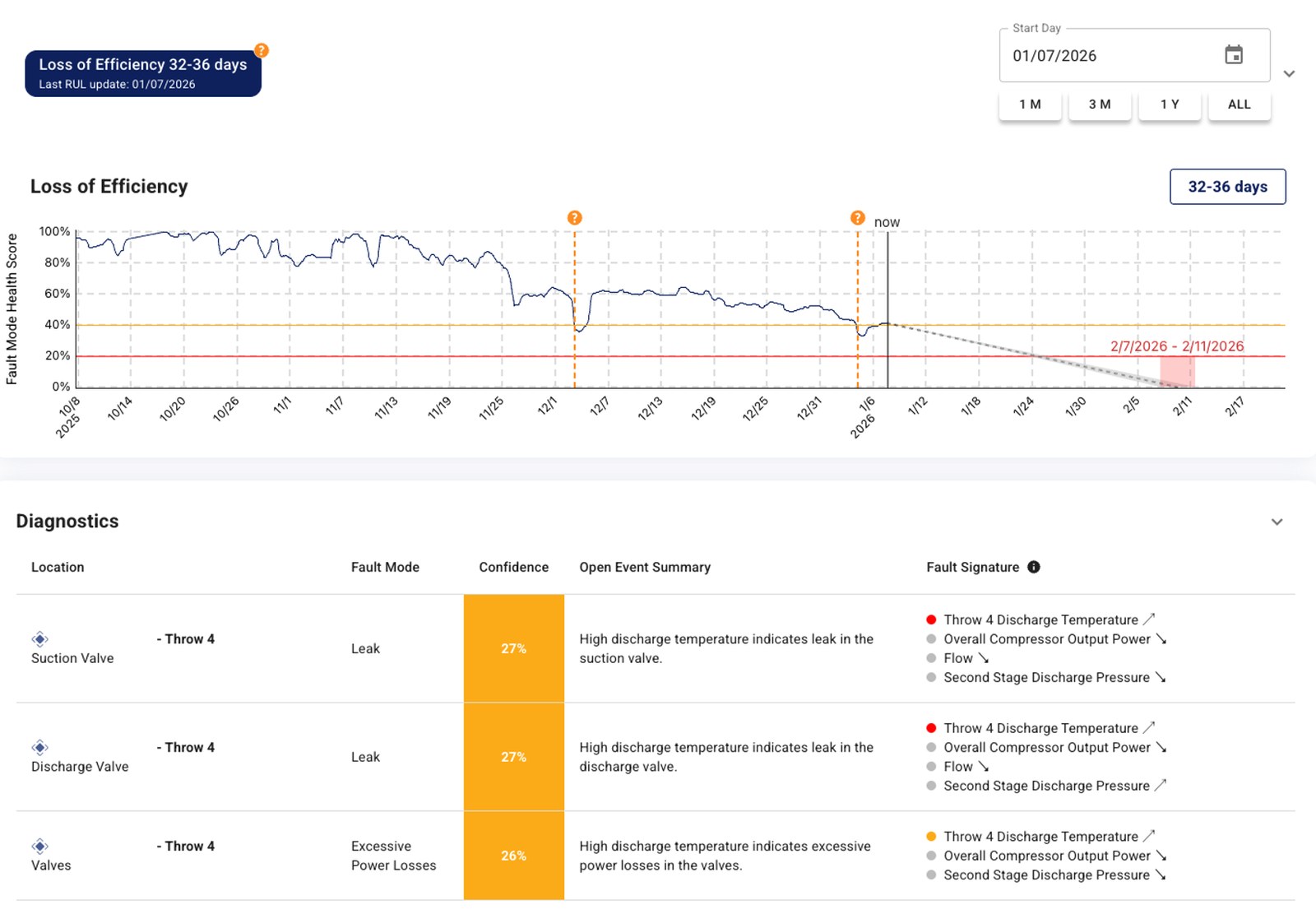
TruPrognostics AI detected a loss of efficiency more than 40 days before the OEM's built-in alarm system would have flagged it. The model returned three plausible fault modes (suction valve leak, discharge valve leak, excessive valve power losses), each with supporting signal evidence and confidence scores.
The machine was serviced during the next scheduled maintenance event, with no unplanned shutdown required.
Free PDF. No upsell. Delivered to your inbox.